What Is Innate Wellbeing?
There’s a type of wellbeing that we all have that is innate and inherent within us all. In other words, we are all born with the capacity to feel well. When we tap into this innate wellbeing, we discover for ourselves that life can be so much easier and more enjoyable. Unfortunately, most of us have a lot of thinking that can get in the way of us experiencing this inherent wellness.
We were all born perfect, whole and complete with access to happiness, peace and contentment. The thing is, that this innate wellbeing can get clouded over and hidden with many negative beliefs and painful emotions.
When we truly realise that we were born with wellbeing, the question then goes from “how can I learn wellbeing?” to “how can I tap into this innate wellbeing?” Or, “what is getting in the way of my natural happiness?” Resilience is us returning to this natural inherent state of wellbeing.
These latter questions are the most helpful questions to ask and it leads to an entirely different way of seeing things. We can go from thinking that we have to work hard to feel good and learn lots of tools and techniques to earn our wellbeing and resilience. To then moving to a place of knowing that we have everything we need to feel good inside, and it becomes a process of uncovering those qualities.
Innate Qualities Of Wellbeing
There’s certain qualities that we all have access to such as:
- Presence
- Adaptability
- Resilience
- Curiosity
- Joyfulness
- Intuition
- Openness
- Engagement
- Creativity
- Trust
- Compassion
- Natural confidence
These qualities reflect our natural selves.
When I ask groups of people what qualities they need to be their best selves, they almost always state the above qualities. When we reflect on these qualities, we also see that these are all present in young children. We then see that all of these qualities are natural and innate. If this is true, why don't we then feel these qualities all the time?
Our Wellbeing Gets Clouded Over
Unfortunately, through life experiences, we pick up many negative and maladaptive beliefs, thought patterns, painful feelings, and then unhelpful actions and habits resulting from negative experiences. This can all lead to us getting stuck and struggling in life.
The image shows how underneath these negative experiences, beliefs and emotions, we are all born perfect, whole and complete with access to wellbeing, peace, clarity and mental and emotional freedom.
Many people instinctively know this is true. Others experience some resistance. That resistance clouds over your peace and happiness and we call it a blind spot - more on this in a moment...
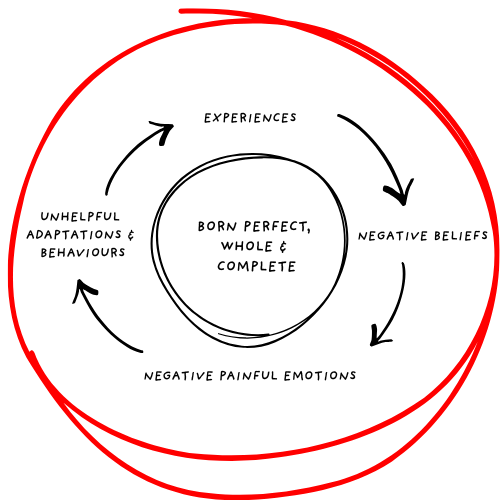
Some of the mind-made obstacles that we learn through stressful and painful experiences can lead to:
- Self-doubt
- Fear of failure
- Self-criticism
- Worry
- Negative thoughts
- Overthinking
- Rejection / Fear of looking bad
We can categorise the above as unhelpful thoughts which result in negative emotions, resulting in adaptive and unhelpful habits.
Blind Spots
Most of the thinking that gets in the way of our innate wellbeing is unconscious. In other words, it's outside of our awareness. We all have blindspots that cover up our wellbeing and our natural performance and we don't even know it's there. Working with a therapist like myself is the process of uncovering these blindspots so you can tap into feeling good and acting in a way that feels productive for you.
Any thought that you have that says “but my well-being is not innate”, or “It’s not as simple as that”, is the precise thing that’s getting in the way of you experiencing your innate well-being. Said another way, the thought that your wellbeing is not innate, is clouding over you feeling whole, and that is why you’re not feeling at ease, you’re not feeling peace, and you’re certainly not tapping into flow state.
We are not born worrying about what people think about us. We’re not born worrying about not being good enough, or of being a failure. All of those negative beliefs are learnt. And so therapy is a process of looking beneath those beliefs and clearing them out so that you're left in your natural state - not a state that has learnt, but a state that is inherent within us all. Healing then becomes more about unlearning the baggage that we've inherited through experiences.

Stress & Burnout Prevention
Human beings have an innate capacity for accessing wellbeing and resilience that is not taught. Knowing this (and remembering it) is a significant protective factor for stress and improves mental health and wellbeing measures. It’s called the innate health realisation theory.
Research shows that we are 60% more likely to thrive when we remember that our wellbeing is innate.
Because this wellbeing is already in existence, it doesn’t need to be taught, it just needs re-accessing. In some cases what is required is more of an unlearning, to access this wellbeing.
In other words, we just need to unlearn the conditioning we’ve picked up that clouds over our innate wellbeing and our ability to bounce back to this wellbeing (resilience).
Measures show that those who know about their innate health and wellbeing, score more favourably on the following questions:
- I keep thinking about things that went wrong
- Negative thoughts stay with me for a long time
- When I feel bad, it is easy to shift to other thoughts
In conclusion having an understanding and awareness of your innate health correlates with higher wellbeing and resilience, and lower anxiety and depression outcomes, with stress levels remaining stable during a significantly stressful event.
Building Resilience
Given that our wellbeing is innate, how do you bounce back to that state when you’re not in it?
We are born into a state of wellbeing that despite what thinking we might have that says otherwise, does not go anywhere. It is always underneath whatever thoughts and feelings we have clouding over it. Any other state is a deviation away from our natural birth-given state.
Resilience is remembering that our wellbeing is innate whilst in a triggered or dysregulated state. This is often enough to help you bounce back to that state, or at least let go of whatever thoughts and feelings you are having that is clouding over your wellbeing. In other words, knowing your wellbeing is innate is a protective factor against stress, burnout, depression and anxiety.
Tapping Into Your Innate Wellbeing?
If you're interested in learning more about this approach to innate wellbeing, I wrote a book about it. It's called A Clear Mind: The Less Is More Mindset To Wellbeing & Performance. Why performance? Because there's a type of natural performance that comes from feeling good. When you feel well, you act in helpful productive ways that lead to better results in life.
Wellbeing and performance can be incredibly natural. Therapy is not something that is hard work that uncovers all of your deepest darkest secrets. Working with me is a process of clearing out the thinking that is covering up your innate well-being, happiness and performance, and it's and far more easy and enjoyable process than you might think.
I teach an approach that leads to less thinking, not more. People that tap into this approach discover more clarity and freedom of mind leading to more ease and peace in life.
If you're interested in working one-on-one with me and tapping into your innate wellbeing, you're welcome to book a free 20 minute call with me now: